Have You Carried Your Cloth Bags to the Store This Week?
Richard
Rohr, in his book Everything Belongs: The
Gift of Contemplative Prayer, writes:
“This
may
seem odd, coming from a Center of Action and Contemplation
that works to improve people’s
lives and is committed to social change, but after
eight years at the Center I am primarily teaching
contemplation. I’ve
seen far too many
activists who are not the answer. ... Their head answer is
largely correct, but the energy, style, and the soul are not. They may
have the answer, but they are not themselves
the answer. In fact, they are often part of the problem.”
Having spent much of our
earlier lives in ministry working
with social activism as a way to interact about the Gospel in the
world, I
concur. Activism of
any kind can be
dangerous as no activism at all. Rohr
continues, “Overly zealous reform tends to corrupt the reformers, while
they
remain incapable of seeing themselves as unreformed. We need less
reformation and more
transformation.”
Keeping this in mind, I have
been diligent in praying first over
a big idea that God may have
dropped into my heart and was one of the reasons I journeyed to Kenya
this last
February. This idea
has become The Global Bag Ladies Project
(where every
bag has a story). The
concept is to
link the ecological need for consumers to carry sturdy cloth shopping
bags to overseas
cottage industries to the shopping constituencies of churches, service
organizations and not-for-profits.
A bag
might be imprinted with a phrase like this:
THIS
BAG IS DESIGNED BY AFRICAN GRANDMOTHERS
TO PRESERVE THE LIVES
OF HIV/AIDS-ORPHANED GRANDCHILDREN.
The
goals of The Global Bag Ladies Project
would be
to
Fill
a growing felt need for cloth bags in increasingly
ecologically concerned societies.
Sensitize
consumers to the positive impact of
the small act of
carrying reusable cloth bags for
shopping.
Provide
sustainable income for craftswomen and
artisans in a variety of countries.
Advertise
the solution to plastic/paper
bag-pollution in the actual marketplace, while
at the same time raising awareness
to the concept of microenterprise (small loans to
entrepreneurs too poor to achieve bank
loans).
Help
participating churches, service
organizations, and not-for-profits to begin thinking
“glocally” (which means while
living locally, considering that the most
casual decisions of Americans can
adversely, if not disastrously, affect the
global economy).
Obviously,
this is an idea too big
for me (or our small Mainstay Ministries organization) to achieve on my
own. You can see, I
think, why I feel the
need to spend time in prayer whenever the concept of The
Global Bag Ladies Project crosses my mind (which is
frequently
obsessive).
Lois
Shaw, my contact in Kenya,
heads up
promotional enterprises for the Nairobi Evangelical Graduate School of
Theology,
where her husband is a professor. She
has established an ingenious tourist
enterprise, which can only be termed “reverse missiology.” On one tour,
twenty-some
Canadian businesswomen
traveled to Nairobi,
stayed in the Guest House on campus, attended the vibrant Nairobi
Chapel (one
of the largest churches in the city), then visited sustainable-income
projects
in the slums and across the city, accompanied by the grad students who
were
developing these projects. Their
assignment: To draw
on their own
resources and expertise to contribute to these sustainable income
ventures or
begin new ones.
Remarkably,
none of these Canadian
business women were Christians. They
certainly saw love in action. “Going to this church,” remarked one, “is
like
attending a rock concert!” Again
and
again, they heard the joyful witness of slum-dwellers testifying of
God’s
loving provision and providence.
I and Carla
Boelkens, a member of a
Hungry Souls listening group, interviewed five women who were
HIV/AIDS
widows, themselves testing positive for the disease. One of the
Canadian women had established
microcredit loans, taught them how to put together business plans, and
with
some 35 children to care for (orphans of brothers or other family
members
besides their own offspring), were selling dried fish, procuring bolts
of
fabric in
Uganda and cutting them into lengths for skirts, and making jewelry or
candles
and establishing small businesses. They
were able to pay their rent, clothe and feed their families, and send
the
children to school. The
post-election
violence, however, hit the poor the hardest. Some 1000 people were
slaughtered; an overwhelming
350,000 became internally
displaced refugees. These
women had been
burnt out of their homes in the slums (and consequently their
businesses). Fleeing
for their lives, they had lost
everything.
“Can
you start again?” Carla and I
asked. “Oh, yes,”
they said with shining
eyes. “God will
take care of us. He
will help us.”
At
that point we begin talking
about putting together business plans, which their Canadian mentor had
taught
them to do. “Oh,
teach me,” I insisted. “Teach
me how to put a business plan
together.”
“First,”
they said, each woman
contributing when the other before her left off. “First you must decide
on the business. Next you must know the
environment and what
is needed. Then you
must choose the materials. Now
you must sit down and plan what you want
to do. Budget first
before you start
buying. Determine
the raw cost and how much
the market will bear, then figure your margins (five times over basic
cost plus
expenses). Carefully
choose the place where
you will sell your products. Then
raise
enough capital.”
As
advised by Nairobi sisters, I am now in the middle of
putting together a draft business plan for The
Global Bag Ladies Project. However, the
more I think and pray about it, the more I am convinced that I need
help.
So Can You
Help Us? Or Do You Know of People Who Can Help Us?
I
have friends with microenterprise
and community-development backgrounds, and I will begin contacting
them, but
right now we need help for:
Someone with
a business background to take the draft plan and help us develop it
fully.
People
who are connected with granting foundations that will recommend our
grant
proposal and inquire as to whether the granting organization will
receive our
proposal asking for start-up funds.
Folk
in the manufacturing (particularly specialty clothing manufacturing)
who
know the ins and outs of
import/export.
Any
point person who wants to take on the catalytic role of moving a
project
like this forward—and who might, depending upon funding, even work
themselves into a part-time job.
Intercessors
who take this on as a prayer effort to undergird our prayer
work with their own.
Whenever
my adrenalin starts
rushing with excitement at the potential of this, I yank myself back to
reality: “This is an idea that is too big for you to deliver.” I remind
myself that any
activism regarding improving
the world must come out of patient, unrushed, centered contemplation
that
focuses my mind on God.
My
role is to pray and to walk only
through the doors that open to me. Oh, yes—then
to ask this question, “Have you carried your cloth bags to the store
this
week?” (David did
yesterday, proudly holding
up his sturdy red cloth Sears bag with the Craftsman imprint for me to
see: “See, I
remembered.”)
Karen Mains
Stratford Shakespeare Festival
July 7 - 12, 2008
The cost for six plays, 5 nights housing in delightful
B&Bs, chats with the actors, picnic along the Avon, lunch with
the Mainses, delightful mind-challenging conversations each morning
over breakfast is $1100 per person per shared room (it is $300 extra
for a single room). A $500 deposit will reserve your place. We must
have all reservations by May 2008 and full payments by June 1, 2008.
Respond to David Mains (
)
as soon as you know your plans; that will help us greatly. We have 4
B&Bs reserved and almost filled and will have to reserve
another if our count goes higher. Bravo for the Bard!
Microenterprise Trip Opportunity
If you
are interested in studying the effects of microenterprise ventures in
Kenya, we are putting together a small group in conjunction with
Nairobi Evangelical Graduate School of Theology to journey to Nairobi
next year, March 25 to April 6, 2009. The itinerary and the
pricing are still being negotiated. Contact Karen Mains (
)
or by phone
at 630-293-4500 and we will get back to you when this
information is finalized.
Reminder!
The Soulish Food e-mails are being
posted biweekly on the Hungry Souls Web site. Newcomers can look that over and decide if they want to
register on the Web site to receive the newsletter. You might
want to recommend this to friends also. They can go to www.HungrySouls.org.
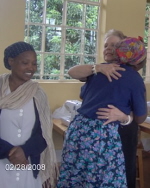
Karen
in Kenya, February 2008. Greeting women (refugees) in a sustainable-income sewing
project called Amani ya Juu.
"I remind
myself that any
activism regarding improving
the world must come out of patient, unrushed, centered contemplation
that
focuses my mind on God."
Recommended Reading
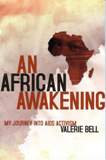
An African
Awakening: My Journey into AIDS Activism By Valerie Bell
Enter the world of AIDS and prepare to be bombarded by overwhelming
statistics, confusing medical acronyms, and complex global
inequities. In her own conversational style, Valerie Bell
crashes through the clutter as an earnest seeker bent on understanding
the world’s greatest humanitarian emergency and how one person can make
a real difference.
Highly revealing and challenging, Bell’s soulful reflections resemble
intimate journal entries from a pilgrim intent on seeking God in all of
His creation; a world that includes wrenching poverty, social injustice
and AIDS.
Bell provides a useful guide in understanding the critical issues
pertaining to global AIDS. On a deeper level, An African
Awakening is an essential companion if compassionate
response is a
life-long goal. This book helps answer the inevitable
question that arises when one experiences a transforming interaction
with victims of the AIDS pandemic: Now what?
(Steve W. Haas, Vice President, World Vision/United States)
VALERIE BELL is an author who
travels widely as a conference speaker and is frequently a guest on
radio and TV. She lives with her husband, Steve, in Kildeer,
Illinois.
God Through the
Eyes of the Artist and the Artist In the Eye of God
October 24 - November 10, 2008
This is a journey for men and women. The land fee is $2592. Half
($1296) is due by May 1, 2008. The balance is due August 1, 2008.
Airfare is not included. Depending upon the exchange rate (the dollar
being low), we may have to add a bit more to the land price, but we
hope not to do this.
If you can pay your full fee by May 1, 2008, we will be able to give
you a reduction of $200.
If you have any questions,
contact Karen Mains (
)
or Valerie Bell (
).
We can provide you with a flyer that has all the details and the
general itinerary or you can go to the travel site at www.Hungry-Souls.com
to print off the pages you need for full information.